Polar Coordinates
Polar CoordinatesExpected Educational ResultsBloom’s TaxonomyPolar Coordinate SystemFour Cartesian Points Represented in Polar CoordinatesPoints in the Polar Coordinate SystemDefinition: Point in the Polar Coordinate SystemDefinition: Radial CoordinateDefinition: Angular CoordinateNon-uniqueness of Polar CoordinatesRotations in the Polar PlaneInvestigation 01Investigation 02CC BY-NC-SA 4.0
Author: John J Weber III, PhD Corresponding Textbook Sections:
Section 10.3 – Polar Coordinates
Expected Educational Results
Objective 16–01: I can convert a point between polar coordinates and cartesian coordinates.
Objective 16–02: I can convert equations between polar coordinates and cartesian coordinates.
Objective 16–03: I can use technology to sketch a polar curve.
Objective 16–04: I can find the derivative of a polar curve.
Objective 16–05: I can use the derivative of a polar curve to find the equation of the tangent line to the curve, points where the curve has horizontal tangent lines, and points where the curve has vertical tangent lines.
Bloom’s Taxonomy
A modern version of Bloom’s Taxonomy is included here to recognize various different levels of understanding and to encourage you to work towards higher-order understanding (those at the top of the pyramid). All Objectives, Investigations, Activities, etc. are color-coded with the level of understanding.

Polar Coordinate System
The cartesian, or rectangular, coordinate system is the coordinate system that you have used in your previous mathematics classes.
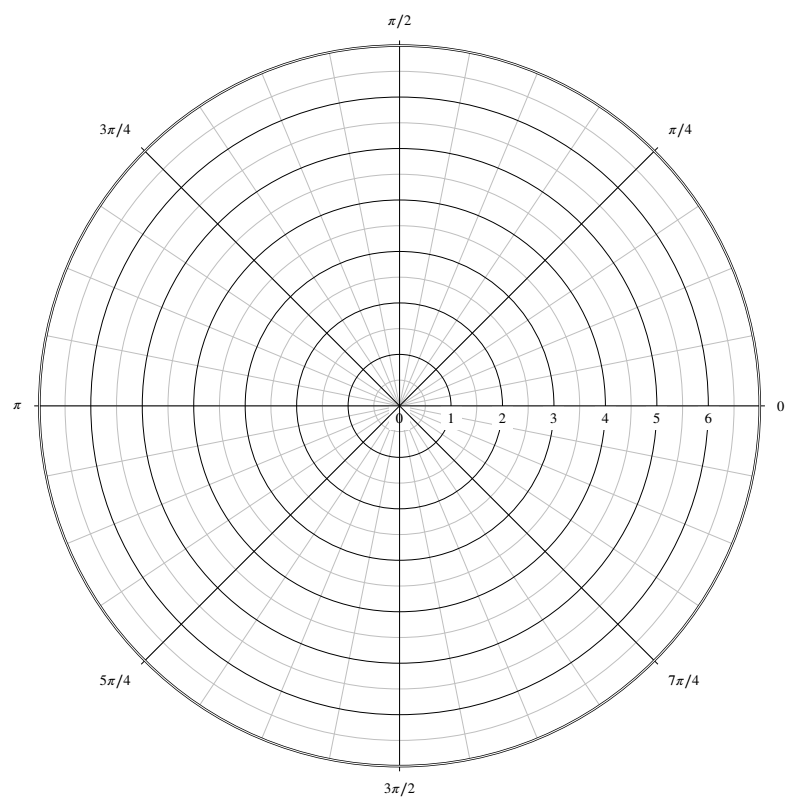
The polar coordinate system is shown below:
Four Cartesian Points Represented in Polar Coordinates
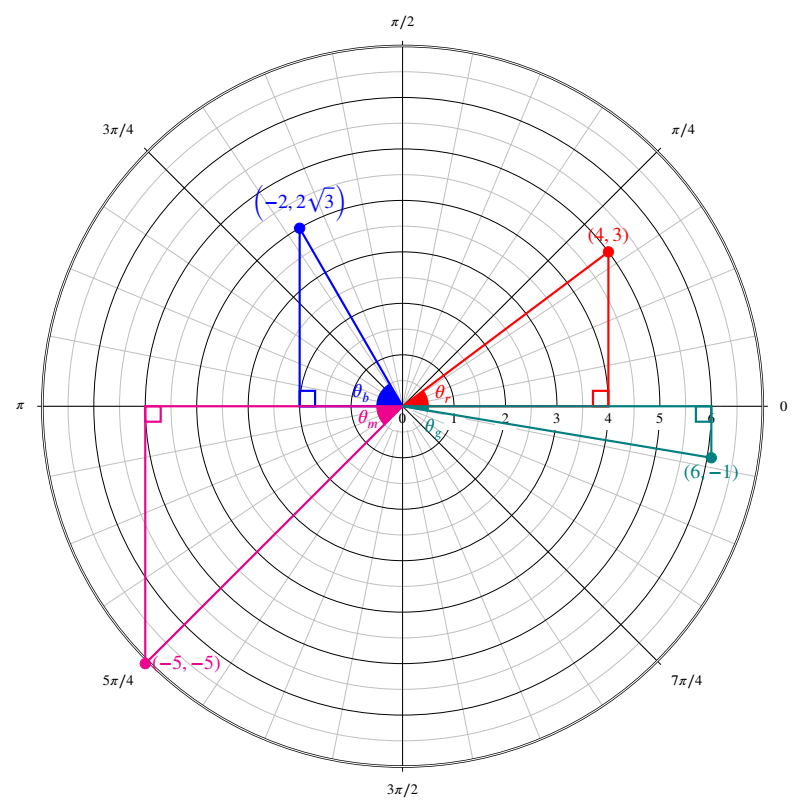
Points in the Polar Coordinate System
Definition: Point in the Polar Coordinate System
A point in the polar coordinate system has the form
Definition: Radial Coordinate
The radial coordinate the distance the point is from the center of the polar coordinate system. The radial coordinate is represented by
Definition: Angular Coordinate
The angular coordinate is the angle, in radians, of the point from the positive
Non-uniqueness of Polar Coordinates
Any point in the polar coordinate system can be represented by infinitely-many coordinate pairs.
Rotations in the Polar Plane
All of the following polar points are equivalent:
The radial coordinate may be negative. When changing the sign of the radial coordinate from
Thus, each of the following polar points are equivalent:
Investigation 01
Plot the following points
Investigation 02
Use your trigonometric knowledge to explain why all the the polar points are equivalent, i.e., the all reference the same polar point):
CC BY-NC-SA 4.0
This work is licensed under a Creative Commons Attribution-NonCommercial-ShareAlike 4.0 International License [http://creativecommons.org/licenses/by-nc-sa/4.0/].
Created: Tuesday, 3 November 2020 6:51 EDT Last Modified: Wednesday, 20 October 2021 - 04:30 (EDT)