Volumes
VolumesExpected Educational ResultsBloom’s TaxonomyVolumesMethodsDefinition: Volume by Disk MethodDefinition: Volume by Washer MethodDefinition: Volume by Cylindrical ShellsProcedureInvestigation 08CC BY-NC-SA 4.0
Author: John J Weber III, PhD Corresponding Textbook Sections:
- Section 6.2 – Volumes
- Section 6.3 – Volumes by Cylindrical Shells
Expected Educational Results
- Objective 11–1: I can set up the integral to compute the volume obtained by rotating a region about an axis.
- Objective 11–2: I can evaluate the integral to compute the volume obtained by rotating a region about an axis using FTC-II.
Bloom’s Taxonomy
A modern version of Bloom’s Taxonomy is included here to recognize various different levels of understanding and to encourage you to work towards higher-order understanding (those at the top of the pyramid). All Objectives, Investigations, Activities, etc. are color-coded with the level of understanding.

Volumes
Methods
Definition: Volume by Disk Method
The area
Definition: Volume by Washer Method
The area
Definition: Volume by Cylindrical Shells
The area
Procedure
Sketch both curves.
Identify the region enclosed by both curves.
Sketch a typical rectangle within the region where every potential rectangle starts and ends at different curves:

Identify the axis of rotation in the graph (use dotted line to quickly identify this axis in your drawing).
Find intersection(s) of curves, by
- Setting
- Setting
- Setting
Identify the method (dashed lines in the following pics are axes of rotation). Explain.
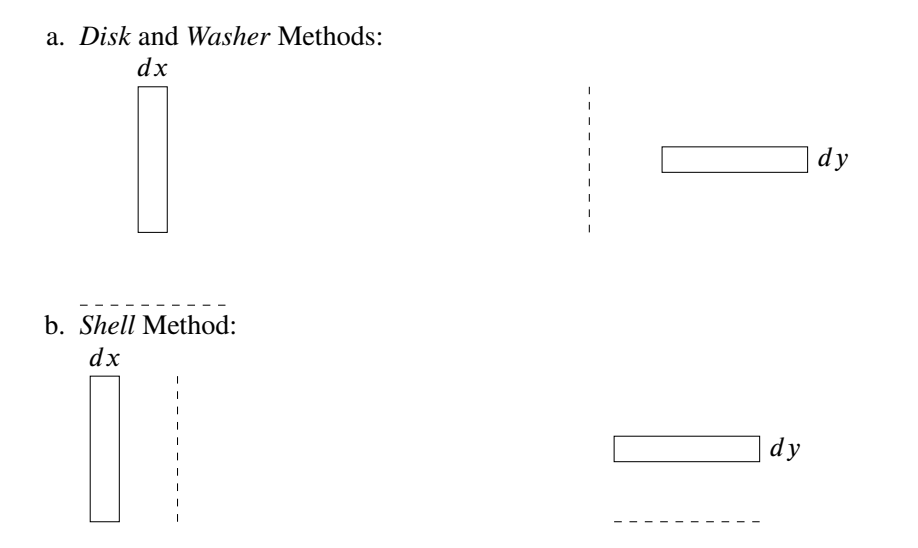
Set up the integral.
Evaluate the integral.
Investigation 08
- Use any software program to estimate the volume of the solid obtained by rotating about the
- Use any software program to estimate the volume of the solid obtained by rotating about
CC BY-NC-SA 4.0
This work is licensed under a Creative Commons Attribution-NonCommercial-ShareAlike 4.0 International License [http://creativecommons.org/licenses/by-nc-sa/4.0/].
Last Modified: Tuesday, 29 September 2020 11:49 EDT