Substitution Rule
Substitution RulePrerequisite KnowledgeAlgebraProperties of ExponentsRational ExponentsCheck Your WorkUse Technology to Express RadicalsDistributive PropertyCheck Your WorkUse Technology to Rewrite Using AlgebraProperties of Logarithmic FunctionsCheck Your WorkUse Technology to Rewrite Using AlgebraCC BY-NC-SA 4.0
Author: John J Weber III, PhD Corresponding Textbook Sections:
Section 5.5 – The Substitution Rule
Prerequisite Knowledge
Algebra
Properties of Exponents
Rational Exponents
Check Your Work
Use Technology to Express Radicals
Mathematica
x1(* Example: Represent cubed root of x^2 *)2Surd[x^2,3]3
4(* The following is NOT equivalent to the above *)5x^(2/3)Warnings:
Be very careful with the syntax. Syntax is the set of rules on how to write computer code. Every software program has its own unique syntax. Some basic Mathematica syntax is located at: https://www.jjw3.com/Common_Mathematica_Code.html.
Distributive Property
and
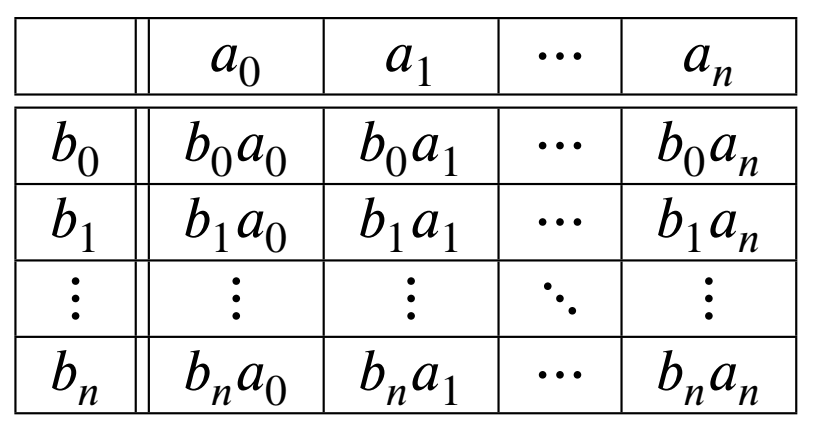
Distributive Property – Table Form
Distributive Property – Method of Detached Coefficients
Example 01:
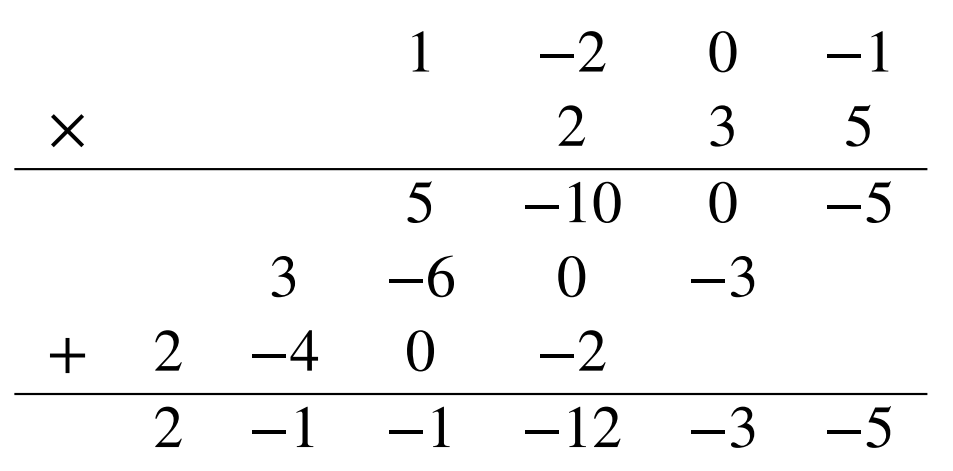
which corresponds to the polynomial
Check Your Work
Use Technology to Rewrite Using Algebra
Mathematica
NOTE: On all Assessments, you may use Mathematica to rewrite any expression without showing any work.
x
1(* Example 01: Expand (x^3-2x^2-1)(2x^2+3x+5) *)2Expand[(x^3-2x^2-1)(2x^2+3x+5)]3
4(* Example: Expand (x^2+3x-2)/x *)5Expand[(x^2+3x-2)/x]Warnings:
Be very careful with the syntax. Syntax is the set of rules on how to write computer code. Every software program has its own unique syntax. Some basic Mathematica syntax is located at: https://www.jjw3.com/Common_Mathematica_Code.html.
To execute code (including comment codes), press and hold the SHIFT key and press the ENTER key.
Mathematica may return a result in a different, but equivalent, form than your answer.
Matlab
NOTE: Mathematica is used here to verify definite integrals. On all Assessments, you must show that you understand the Calculus I concept of using
x
118111% Example 01: Expand (x^3-2x^2-1)(2x^2+3x+5)2
3% Declare the independent variable4syms x5
6% Integrate the function7expand((x^3-2*x^2-1)*(2*x^2+3*x+5))8
9% Example 02: Expand (x^2+3x-2)/x10expand((x^2+3x-2)/x)Link to Mathematica Notebook file containing the above code: http://calc.jjw3.com/math2212/nb/02d_Indefinite_Integrals.nb.
Warnings:
Be very careful with the syntax. Syntax is the set of rules on how to write computer code. Every software program has its own unique syntax. Some basic Mathematica syntax is located at: https://www.jjw3.com/Common_Mathematica_Code.html.
expand( ) for has at least one argument:
The expression to be simplified.
The Matlab syntax for
Remember to use parens
Matlab requires
Python
NOTE: On all Assessments, you may use Python to rewrite any expression without showing any work.
Be very careful with the syntax. Syntax is the set of rules on how to write computer code. Every software program has its own unique syntax. Some basic Python syntax is located at: https://www.jjw3.com/Common_Python_Code.html.
Python requires
Python requires
Remember to use parens
You can use pprint( ) for pretty print.
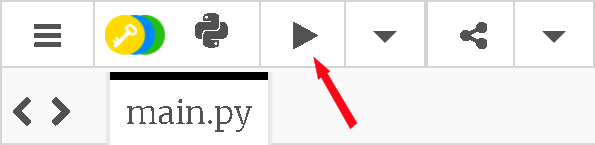
To execute code, press the “View the result” button:
Properties of Logarithmic Functions
The only property of logarithmic functions needed for
Check Your Work
Use Technology to Rewrite Using Algebra
Mathematica
NOTE: On all Assessments, you may use Mathematica to rewrite any expression without showing any work.
NOTE: This line of Mathematica code rewrite a log expression using the Power Property of Logarithms.
xxxxxxxxxx21(* Simplify: ln(x^3) *)2FullSimplify[Log[x^3], x>0]Warnings:
Be very careful with the syntax. Syntax is the set of rules on how to write computer code. Every software program has its own unique syntax. Some basic Mathematica syntax is located at: https://www.jjw3.com/Common_Mathematica_Code.html.
The argument
To execute code (including comment codes), press and hold the SHIFT key and press the ENTER key.
CC BY-NC-SA 4.0
This work is licensed under a Creative Commons Attribution-NonCommercial-ShareAlike 4.0 International License [http://creativecommons.org/licenses/by-nc-sa/4.0/].
Created: Monday, 18 January 2021 09:05 EDT Last Modified: Monday, 08 May 2023 - 10:59 (EST)