Fundamental Theorem of Calculus (FTC)
Fundamental Theorem of Calculus (FTC)Expected Educational ResultsBloom’s TaxonomyApplication of FTCDefinition: VelocityDefinition: AccelerationDefinition: DisplacementDefinition: Total Distance TraveledArea Under the CurveInvestigation 21HomeworkCC BY-NC-SA 4.0
Author: John J Weber III, PhD Corresponding Textbook Sections:
Section 4.9 – Antiderivatives
Section 5.3 – The Fundamental Theorem of Calculus
Section 5.4 – Indefinite Integrals and the Net Change Theorem
Expected Educational Results
Objective 01–01: I can state the Fundamental Theorem of Calculus.
Objective 01–02: I can explain the meaning of the Fundamental Theorem of Calculus – Part I.
Objective 01–03: I can explain the meaning of the Fundamental Theorem of Calculus – Part II.
Objective 01–04: I can determine the properties of an area function using FTC-I and Calculus I.
Objective 01–05: I can evaluate indefinite integrals using the Fundamental Theorem of Calculus – Part I.
Objective 01–06: I can evaluate definite integrals using the Fundamental Theorem of Calculus – Part II.
Objective 01–07: I can use the Net Change Theorem to identify the meaning of
Objective 01–08: Given velocity of an object in motion along a line, I can find the object’s displacement and the total distance traveled.
Objective 01–09: Given acceleration of an object in motion along a line, I can find the object’s velocity, displacement, and the total distance traveled.
Bloom’s Taxonomy
A modern version of Bloom’s Taxonomy is included here to recognize various different levels of understanding and to encourage you to work towards higher-order understanding (those at the top of the pyramid). All Objectives, Investigations, Activities, etc. are color-coded with the level of understanding.

Application of FTC
Definition: Velocity
Let
Definition: Acceleration
Let
Definition: Displacement
Let
Definition: Total Distance Traveled
Let
Area Under the Curve
Example 01:
Let
Solution:
The object is
The displacement is the net area under the curve. This is shown in the Figure below:
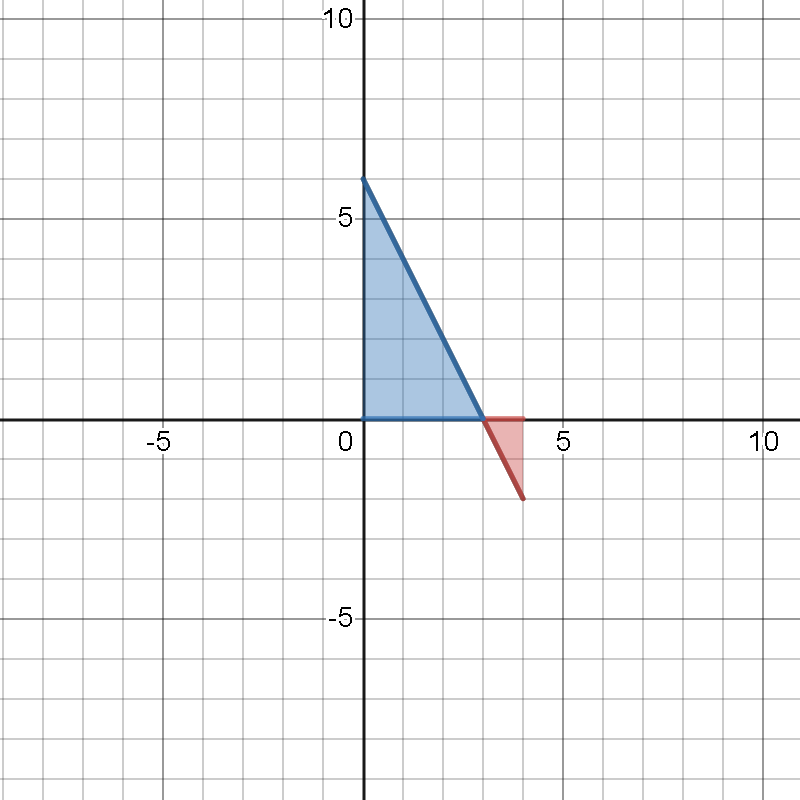
NOTE: The area of the blue triangle is
Example 02:
Let
Solution:
The total distance traveled is the net area under the absolute value of the curve. This is shown in the Figure below:
NOTE: The area of the blue triangle is
The object traveled a total distance of
Investigation 21
Suppose an object moves along a straight line with velocity
Find the total distance traveled on
Find the displacement on
Suppose an object moves along a straight line with acceleration
Find the velocity at time
Find the total distance traveled
Homework
At this time, you should be able to complete the following assignments:
Section 5.4: # 69, 71.
CC BY-NC-SA 4.0
This work is licensed under a Creative Commons Attribution-NonCommercial-ShareAlike 4.0 International License [http://creativecommons.org/licenses/by-nc-sa/4.0/].
Created: Tuesday, 25 August 2020 04:32 EDT Last Modified: Monday, 23 August 2021 - 06:06 (EDT)